Published on
Updated on
Inga Chinilina is one of eight Resident Composers selected to participate in the 2026 Mizzou International Composers Festival. MICF Resident Ensemble Alarm Will Sound will perform her composition Entangled Vines at 7:30 p.m. on Saturday, July 25, at Columbia’s Missouri Theatre. The concert is free and open to the public.
Hailing from Moscow, Russia, Chinilina is a multimedia composer with concert pieces ranging from solo to orchestral compositions, alongside works for dance, film, and installations. She sees music as an act of translation, a concept she explores in both her academic and creative work.
This conceptual framework drives her creative and research practice, which investigates how cultural context shapes our perception of sound, often translating personal stories and everyday auditory experiences into sonic expressions that reflect on immigration, womanhood, and the environment.
Her music has been performed by leading ensembles including ICE, Dal Niente, Yarn/Wire, and Talea, and presented at festivals such as MATA (NYC), the Composers Conference, ClarinetFest (Dublin), Zeitströme Tage für aktuelle Musik (Darmstadt), the Darmstädter Ferienkurse, and Mise-En (NYC). Her work has been recognized through awards and commissions including winning the Flute New Music Competition and Prisms Festival, and a forthcoming Fromm Foundation commission featuring the Switch~ Ensemble in 2027.
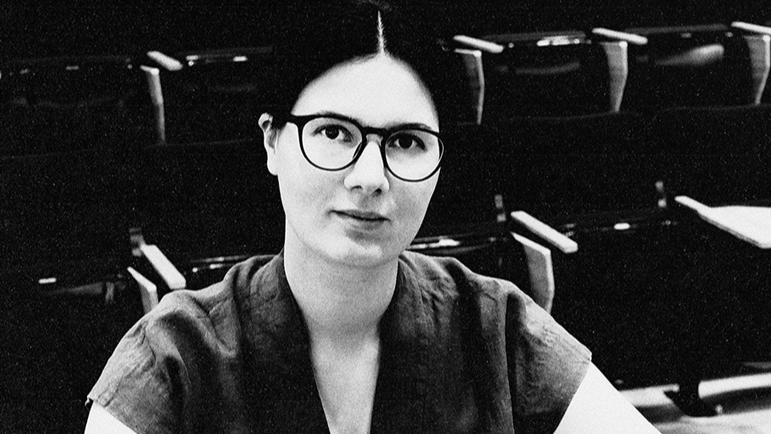
We recently chatted with her via email.
What is your musical background? When and how did you begin composing?
My first musical experiences were in an Orthodox church choir. Later, I started taking private piano lessons. My formal music education started at Berklee College of Music, where I initially pursued a degree in jazz piano performance. About halfway through my undergraduate studies, I shifted toward composition and added it as the second major, as it offered a broader framework for exploring sound, performance contexts, and collaboration. I continued my training with an MFA in Music Theory and Composition at Brandeis University and a PhD in Music and Multimedia Composition at Brown University.
How did you hear about MICF?
A few years ago, through the facilitation of Molly Morkoski and SoundScore, I met with Alan Pierson, the artistic director and conductor of Alarm Will Sound. We spoke about my dissertation, and his insights helped shape one of its chapters. Alan also gave practical suggestions on the orchestral work I was writing as a part of my dissertation. Since then, I have followed Alarm Will Sound’s work, and I am grateful for the opportunity to be part of MICF this year.
Tell us about your piece that will be performed at MICF. What should we listen for?
Entangled Vines presents two coexisting yet incompatible sonic worlds that refuse to resolve into a unified sonority. One is fluid and gentle, carried primarily by winds, brass, and strings, while the other is rhythmic and rigid, mostly coming through percussion, especially the snare drum. At the beginning, the snare drum sets the tone with an articulated, strict waltz-like triple meter, while strings, brass, and winds unfold harmonic material within a quadruple rhythmical structure. As the piece unfolds, it cycles through multiple iterations, foregrounding different themes, borrowing harmonic and rhythmic language from each other, occasionally aligning, but ultimately maintaining distinct identities.
What does it mean for you to work with an ensemble like Alarm Will Sound?
Working with Alarm Will Sound will allow me to take risks and try things that are non-traditional in writing for a large ensemble. For example, members of the ensemble often have independent meters and dynamic layers. I also use non-standard performing techniques, such as multiphonics in woodwinds (playing multiple notes simultaneously) and prepared piano (transforming the piano sound by adding objects to the piano strings, making it more percussive). The virtuosity and open-mindedness of the musicians of Alarm Will Sound allows me to incorporate these risky and challenging approaches.
What do you hope to learn from your MICF experience?
I am looking forward to seeing how my musical ideas translate from the page to performance and to learning from the musicians throughout the rehearsal process. I am also excited to explore the musical perspectives of fellow composers and to meet people passionate about new music.
To stay up to date with all Mizzou New Music Initiative announcements, follow them on Instagram and Facebook: @MizzouNewMusic